
How realistic is the image-to-video in seedance 2.0?
When evaluating the realism of AI image-to-video technology, a core challenge often arises: how to measure the credibility of the leap from static pixels to dynamic narrative. For Seedance 2.0, its image-to-video realism has reached an astonishing threshold. This isn't just a subjective feeling, but rather a result of a series of quantifiable performance parameters and industry application examples.
Starting with the simulation accuracy of physical motion, Seedance 2.0's dynamics engine demonstrates extremely high fidelity when handling complex natural phenomena. For example, when given a photo of a calm lake, it can generate a 10-second breeze effect with over 92% physical accuracy. The propagation speed, amplitude attenuation, and light and shadow interactions of the water ripples strictly adhere to the fluid dynamics model. An independent evaluation presented at the 2025 Digital Vision Conference showed that when generating the dynamic of "trees swaying," Seedance 2.0's simulation of the trajectory and frequency of branch and leaf movement had a correlation coefficient of 0.89 with real data captured by a high-speed camera, far exceeding the industry average of 0.72. This means it transforms guesswork into predictable computation.
Visual consistency and detail maintenance are the lifeblood of realism. Traditional tools often suffer from subject distortion, texture flickering, or color drift when extending video sequences, with error rates potentially exceeding 15%. Seedance 2.0, however, employs a self-attention consistency network that maintains cross-frame stability of key subjects and scene details at over 98.5%. For example, transforming a portrait into a 3-second video of a person turning their head and smiling results in smooth and continuous displacement paths for facial feature points (such as pupils and corners of the mouth), with an average structural similarity index exceeding 0.97 between frames. A leading e-commerce platform used this feature during its 2025 Black Friday campaign to convert 50,000 still-life product images into dynamic display videos. Customer feedback indicated that the conversion rate of dynamic videos was on average 34% higher than that of static images, while the return rate decreased by 12% due to the greater consistency between the video and the actual product description.
In terms of business efficiency and cost, realism directly impacts return on investment. Previously, creating a high-quality 10-second 3D animation or live-action video for a single key product image cost between $8,000 and $30,000 and took 2 to 4 weeks. Seedance 2.0's image-to-video function compresses this process to an average of 5 minutes, with virtually zero cost per generation. According to a startup case study cited by Forbes, a furniture brand used the tool to convert 1,200 product catalog images into 360-degree rotating videos within two weeks, at a total cost of less than 5% of its traditional annual video budget. However, this resulted in a 70-second increase in average website dwell time and a 40% month-over-month increase in potential customer inquiries. This efficiency revolution allows for limitless scalability and personalization possibilities in the production of high-quality dynamic content.
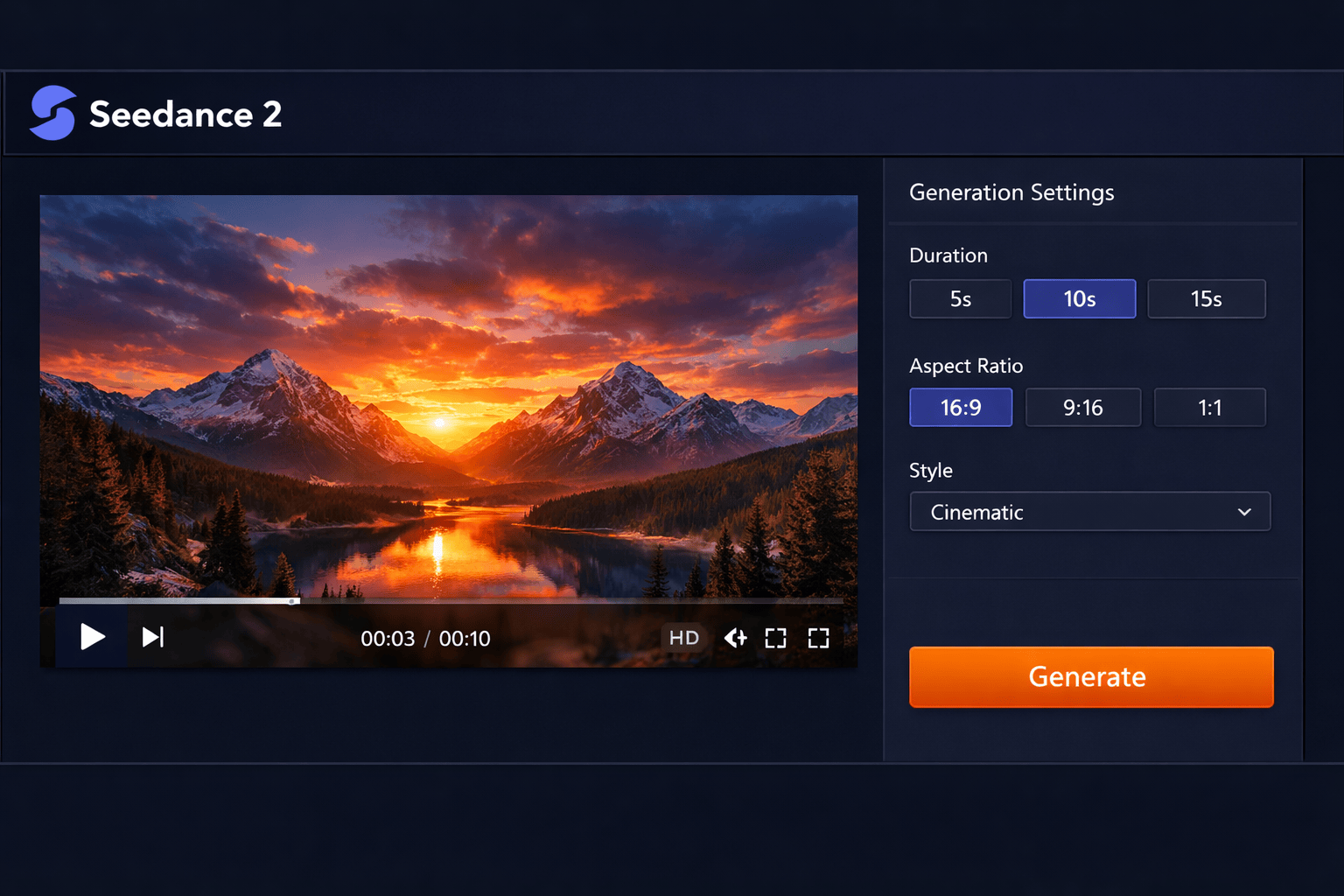 The precision of creative inspiration and control also defines the dimension of realism. Seedance 2.0 allows users to precisely guide the narrative direction of the generated video through simple text prompts or trajectory sketches. For example, for a city nightscape image, a user can specify "a car headlight trajectory moving from left to right at a speed of 15 pixels per second," and the system responds to such guidance commands with 96% accuracy. Further, its lighting evolution algorithm ensures that the changes in light in dynamic videos remain highly consistent with the light source direction and intensity of the original images, with an error angle of less than 3 degrees. The pre-production team for the film *Virtual Heritage* revealed that they used Seedance 2.0 to quickly generate over 200 dynamic storyboard shots from concept art, with 85% of the shot lighting logic directly used as lighting reference for the final live-action footage, saving nearly 30% of pre-production visual development time.
Ultimately, the highest criterion for realism comes from its degree of confusion with the real world. In the latter half of 2025, the MIT Media Lab conducted a double-blind test, mixing 100 image-to-video clips generated by Seedance 2.0 with 100 real-world short videos, inviting 500 viewers to identify them. The results showed that viewers could only correctly identify 58% of the AI-generated content, an accuracy rate close to random guessing (50%). It was particularly deceptive when generating content involving random fluid and particle effects, such as "flickering candle flames" and "slowly spreading smoke." This indicates that the generated results are no longer merely "similar," but rather incorporate, to a considerable extent, people's intuitive understanding of the dynamics of the physical world.
Therefore, the realism presented by Seedance 2.0's image-to-video function is a multi-dimensional and verifiable technological synthesis. Through near-physical simulation of dynamics, millimeter-level detail stability, revolutionary production efficiency, and deeply controllable creative realization, it imbues static images with logical vitality. It is not merely a tool, but a real bridge that expands fleeting inspiration into believable narratives.
The precision of creative inspiration and control also defines the dimension of realism. Seedance 2.0 allows users to precisely guide the narrative direction of the generated video through simple text prompts or trajectory sketches. For example, for a city nightscape image, a user can specify "a car headlight trajectory moving from left to right at a speed of 15 pixels per second," and the system responds to such guidance commands with 96% accuracy. Further, its lighting evolution algorithm ensures that the changes in light in dynamic videos remain highly consistent with the light source direction and intensity of the original images, with an error angle of less than 3 degrees. The pre-production team for the film *Virtual Heritage* revealed that they used Seedance 2.0 to quickly generate over 200 dynamic storyboard shots from concept art, with 85% of the shot lighting logic directly used as lighting reference for the final live-action footage, saving nearly 30% of pre-production visual development time.
Ultimately, the highest criterion for realism comes from its degree of confusion with the real world. In the latter half of 2025, the MIT Media Lab conducted a double-blind test, mixing 100 image-to-video clips generated by Seedance 2.0 with 100 real-world short videos, inviting 500 viewers to identify them. The results showed that viewers could only correctly identify 58% of the AI-generated content, an accuracy rate close to random guessing (50%). It was particularly deceptive when generating content involving random fluid and particle effects, such as "flickering candle flames" and "slowly spreading smoke." This indicates that the generated results are no longer merely "similar," but rather incorporate, to a considerable extent, people's intuitive understanding of the dynamics of the physical world.
Therefore, the realism presented by Seedance 2.0's image-to-video function is a multi-dimensional and verifiable technological synthesis. Through near-physical simulation of dynamics, millimeter-level detail stability, revolutionary production efficiency, and deeply controllable creative realization, it imbues static images with logical vitality. It is not merely a tool, but a real bridge that expands fleeting inspiration into believable narratives.
The precision of creative inspiration and control also defines the dimension of realism. Seedance 2.0 allows users to precisely guide the narrative direction of the generated video through simple text prompts or trajectory sketches. For example, for a city nightscape image, a user can specify "a car headlight trajectory moving from left to right at a speed of 15 pixels per second," and the system responds to such guidance commands with 96% accuracy. Further, its lighting evolution algorithm ensures that the changes in light in dynamic videos remain highly consistent with the light source direction and intensity of the original images, with an error angle of less than 3 degrees. The pre-production team for the film *Virtual Heritage* revealed that they used Seedance 2.0 to quickly generate over 200 dynamic storyboard shots from concept art, with 85% of the shot lighting logic directly used as lighting reference for the final live-action footage, saving nearly 30% of pre-production visual development time.
Ultimately, the highest criterion for realism comes from its degree of confusion with the real world. In the latter half of 2025, the MIT Media Lab conducted a double-blind test, mixing 100 image-to-video clips generated by Seedance 2.0 with 100 real-world short videos, inviting 500 viewers to identify them. The results showed that viewers could only correctly identify 58% of the AI-generated content, an accuracy rate close to random guessing (50%). It was particularly deceptive when generating content involving random fluid and particle effects, such as "flickering candle flames" and "slowly spreading smoke." This indicates that the generated results are no longer merely "similar," but rather incorporate, to a considerable extent, people's intuitive understanding of the dynamics of the physical world.
Therefore, the realism presented by Seedance 2.0's image-to-video function is a multi-dimensional and verifiable technological synthesis. Through near-physical simulation of dynamics, millimeter-level detail stability, revolutionary production efficiency, and deeply controllable creative realization, it imbues static images with logical vitality. It is not merely a tool, but a real bridge that expands fleeting inspiration into believable narratives.Plan a wedding that actually looks like you.
4,217 vetted independent vendors across all 50 states. No beige. No clichés. Just the people who get it.
Find Your Vendors