
When Should You Use Coarse White Fused Alumina Grit 14?
Choosing to use coarse-grained white fused alumina grit (GGA14) often signifies a critical stage in your machining process, driven by the pursuit of high material removal rates, the shaping of specific surface morphologies, or the handling of extreme workpiece conditions. When cleaning weld seams in heavy steel structures, this grit size, approximately equivalent to 1.70 mm of white fused alumina grit, becomes the preferred choice. For example, in the pretreatment of ship decks or bridge beams, using a blasting system with a pressure of 10 bar and a flow rate of 8 cubic meters per minute, coupled with GGA14 grit, can clean one square meter in 90 seconds, improving the rust grade from Sa2.5 to Sa3.0. The resulting 60 to 85 micrometer anchor pattern depth provides optimal adhesion for subsequent coatings, extending the protective life of the coating system from the typical 8 years to over 15 years, and reducing total lifecycle maintenance costs by more than 40%.
In the casting industry, when you need to quickly remove sintered sand, scale, and burrs from the surfaces of large gray iron or cast steel parts, coarse-grained GGA14 is a strategic choice balancing efficiency and cost. A standard shot blasting machine, loaded with No. 14 white corundum abrasive, can process up to 5 tons of castings in a single cycle, improving the surface cleanliness of castings to over 85% within 20 minutes and reducing subsequent finishing time by approximately 30%. A foundry with an annual output of 20,000 tons reported that after systematically adopting this abrasive specification, its overall energy consumption for shot blasting was reduced by 15%, and the abrasive consumption rate stabilized at 1.2 tons per 100 tons of castings processed, resulting in an 18% reduction in surface treatment costs per unit and significantly improving its price competitiveness in the heavy machinery market.
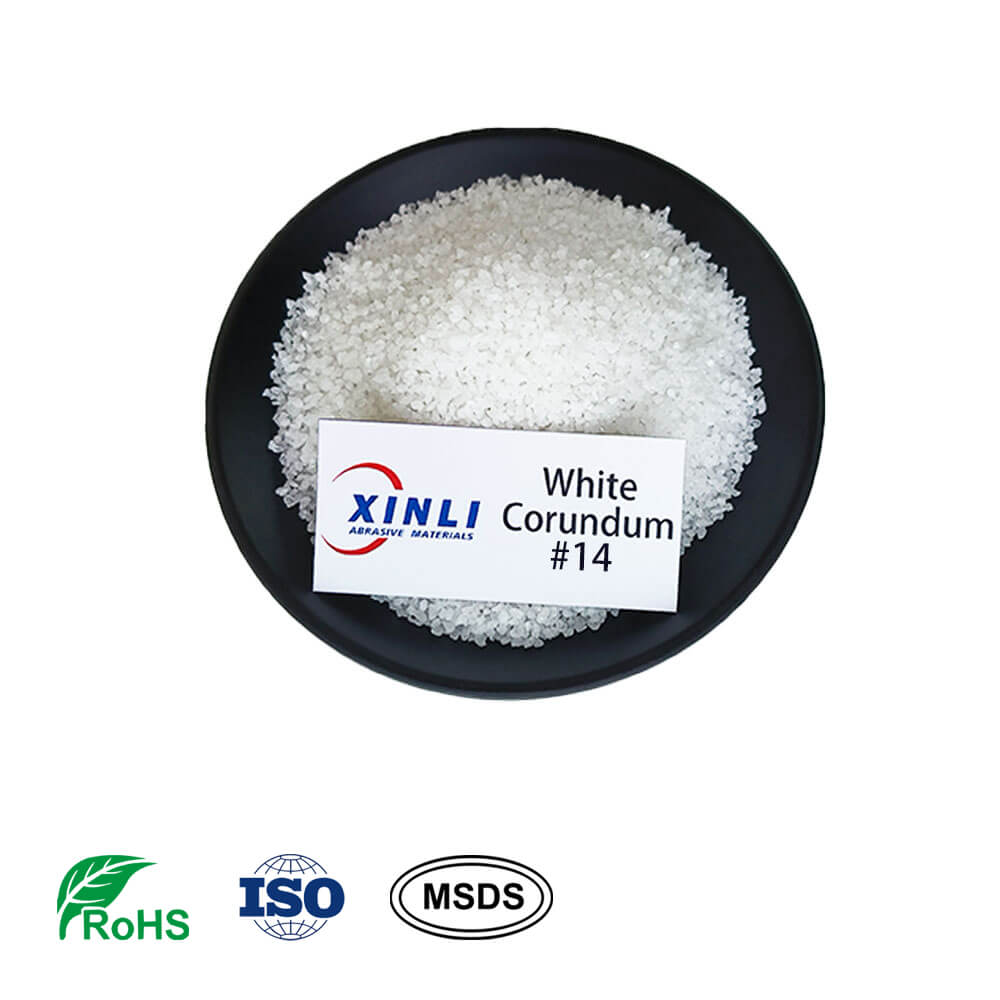 In the stone processing industry, No. 14 grit plays an irreplaceable role in the "singeing" or "hammering" treatment of hard slabs such as granite and marble. Through high-speed blasting, its sharp edges can create dense and uniform pits on the stone surface, forming an anti-slip texture with a depth of approximately 0.5 to 1.0 mm. Production data from a professional stone factory shows that using high-quality No. 14 white fused aluminum grit reduces the processing time per square meter of slab to just 45 seconds, achieving 95% texture consistency and lowering the scrap rate from 7% when using irregular grit to below 2%. This directly addresses the high-end construction market's demand for exterior wall and flooring materials that combine safety and aesthetics, with profit margins for related products averaging 25% higher than standard polished slabs.
Furthermore, in the initial rough grinding stage of composite materials and high-hardness alloys, selecting No. 14 coarse grit is a crucial step in achieving technical specifications. For example, when processing carbon fiber reinforced polymer (CFRP) laminates thicker than 50 mm, No. 14 grit abrasive belts are first used for shaping grinding. Its powerful cutting force can remove more than 15 cubic centimeters of material per minute, quickly reducing flatness errors to within 0.1 mm/m, laying the foundation for subsequent precision polishing with No. 80 or even finer grits. This can optimize the overall processing cycle by 35%. Similarly, for wear-resistant alloy steel plates with a Rockwell hardness of HRC 60, this grit size efficiently constructs the necessary surface roughness profile during the roughening process before preparing the wear-resistant layer.
However, successful application of coarse-grained white fused alumina grit (#14) requires precise assessment of the workpiece material, equipment power, and final process requirements. Incorrect selection can lead to over-cutting, dimensional inconsistencies, or unnecessary deep stress, increasing subsequent fine grinding time by more than 50% to correct. Therefore, best practice is to view it as a highly efficient but precisely controlled tool, typically acting as the "vanguard" in the machining process, clearing the biggest obstacles in the shortest time to pave the way for the "following troops"—the finer-grained abrasives. Understanding this allows for finding the golden balance between improving productivity, controlling budget, and achieving superior surface integrity.
In the stone processing industry, No. 14 grit plays an irreplaceable role in the "singeing" or "hammering" treatment of hard slabs such as granite and marble. Through high-speed blasting, its sharp edges can create dense and uniform pits on the stone surface, forming an anti-slip texture with a depth of approximately 0.5 to 1.0 mm. Production data from a professional stone factory shows that using high-quality No. 14 white fused aluminum grit reduces the processing time per square meter of slab to just 45 seconds, achieving 95% texture consistency and lowering the scrap rate from 7% when using irregular grit to below 2%. This directly addresses the high-end construction market's demand for exterior wall and flooring materials that combine safety and aesthetics, with profit margins for related products averaging 25% higher than standard polished slabs.
Furthermore, in the initial rough grinding stage of composite materials and high-hardness alloys, selecting No. 14 coarse grit is a crucial step in achieving technical specifications. For example, when processing carbon fiber reinforced polymer (CFRP) laminates thicker than 50 mm, No. 14 grit abrasive belts are first used for shaping grinding. Its powerful cutting force can remove more than 15 cubic centimeters of material per minute, quickly reducing flatness errors to within 0.1 mm/m, laying the foundation for subsequent precision polishing with No. 80 or even finer grits. This can optimize the overall processing cycle by 35%. Similarly, for wear-resistant alloy steel plates with a Rockwell hardness of HRC 60, this grit size efficiently constructs the necessary surface roughness profile during the roughening process before preparing the wear-resistant layer.
However, successful application of coarse-grained white fused alumina grit (#14) requires precise assessment of the workpiece material, equipment power, and final process requirements. Incorrect selection can lead to over-cutting, dimensional inconsistencies, or unnecessary deep stress, increasing subsequent fine grinding time by more than 50% to correct. Therefore, best practice is to view it as a highly efficient but precisely controlled tool, typically acting as the "vanguard" in the machining process, clearing the biggest obstacles in the shortest time to pave the way for the "following troops"—the finer-grained abrasives. Understanding this allows for finding the golden balance between improving productivity, controlling budget, and achieving superior surface integrity.
In the stone processing industry, No. 14 grit plays an irreplaceable role in the "singeing" or "hammering" treatment of hard slabs such as granite and marble. Through high-speed blasting, its sharp edges can create dense and uniform pits on the stone surface, forming an anti-slip texture with a depth of approximately 0.5 to 1.0 mm. Production data from a professional stone factory shows that using high-quality No. 14 white fused aluminum grit reduces the processing time per square meter of slab to just 45 seconds, achieving 95% texture consistency and lowering the scrap rate from 7% when using irregular grit to below 2%. This directly addresses the high-end construction market's demand for exterior wall and flooring materials that combine safety and aesthetics, with profit margins for related products averaging 25% higher than standard polished slabs.
Furthermore, in the initial rough grinding stage of composite materials and high-hardness alloys, selecting No. 14 coarse grit is a crucial step in achieving technical specifications. For example, when processing carbon fiber reinforced polymer (CFRP) laminates thicker than 50 mm, No. 14 grit abrasive belts are first used for shaping grinding. Its powerful cutting force can remove more than 15 cubic centimeters of material per minute, quickly reducing flatness errors to within 0.1 mm/m, laying the foundation for subsequent precision polishing with No. 80 or even finer grits. This can optimize the overall processing cycle by 35%. Similarly, for wear-resistant alloy steel plates with a Rockwell hardness of HRC 60, this grit size efficiently constructs the necessary surface roughness profile during the roughening process before preparing the wear-resistant layer.
However, successful application of coarse-grained white fused alumina grit (#14) requires precise assessment of the workpiece material, equipment power, and final process requirements. Incorrect selection can lead to over-cutting, dimensional inconsistencies, or unnecessary deep stress, increasing subsequent fine grinding time by more than 50% to correct. Therefore, best practice is to view it as a highly efficient but precisely controlled tool, typically acting as the "vanguard" in the machining process, clearing the biggest obstacles in the shortest time to pave the way for the "following troops"—the finer-grained abrasives. Understanding this allows for finding the golden balance between improving productivity, controlling budget, and achieving superior surface integrity.Plan a wedding that actually looks like you.
4,217 vetted independent vendors across all 50 states. No beige. No clichés. Just the people who get it.
Find Your Vendors